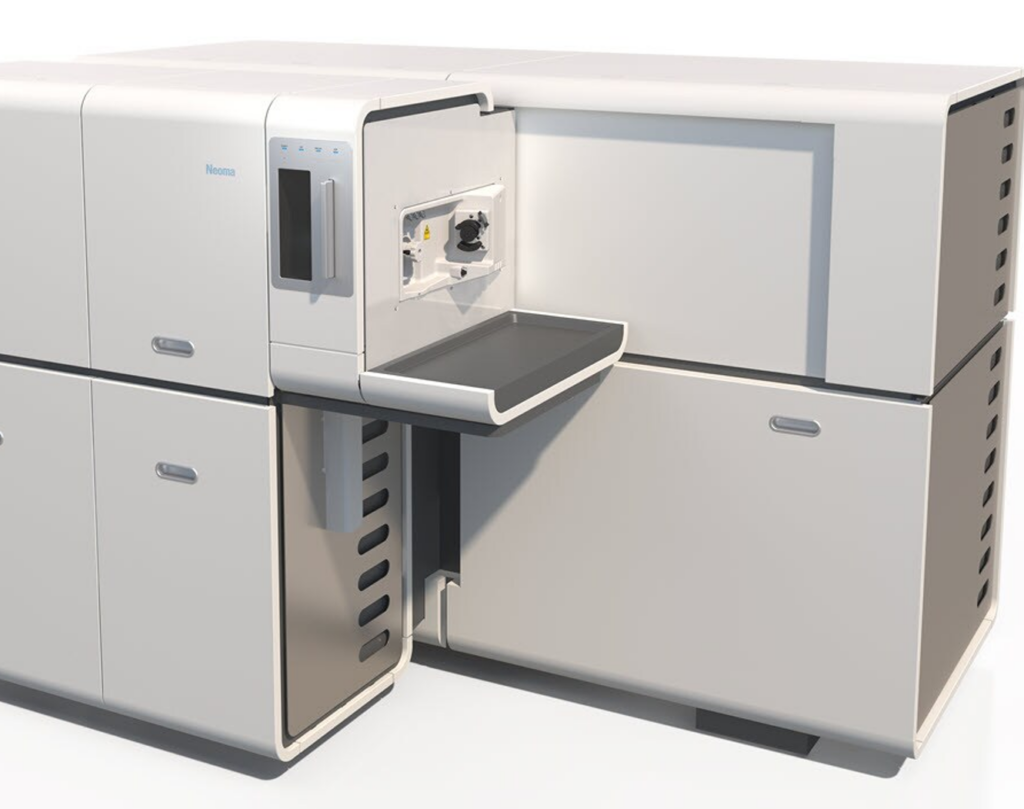
A espectrometria de massas ICP-MS é uma técnica analítica poderosa.
Além disso, Sr ISOTOPES and MC ICP MS medem isotótopos.
Ele combina dois componentes principais: um plasma induzido acoplado (ICP), que converte a amostra em íons. Em seguida, um espectrômetro de massa (MS) separa e mede esses íons de acordo com a razão massa-carga. Isso permite que Sr ISOTOPES and MC ICP MS forneçam medições precisas.
ICP-MS is particularly valuable because it provides:
Extremely high sensitivity, with detection limits reaching parts-per-trillion (ppt) levels for many elements.
Multi-element analysis, allowing many elements across the periodic table to be measured during a single analytical session.
Isotope ratio measurements, which are widely used in geochemistry, geochronology, environmental tracing, and other fields.
High precision and accuracy, particularly when using instruments designed for isotope-ratio measurements such as MC-ICP-MS.
Very small sample requirements, especially when ICP-MS is coupled to laser ablation.
In simple terms, ICP-MS allows us to determine what elements are present in a sample, how much of each element is present, and, in many applications, their isotopic composition. This combination makes ICP-MS one of the most versatile analytical tools available for modern geochemical and environmental research.
Small Samples, Powerful Analyses
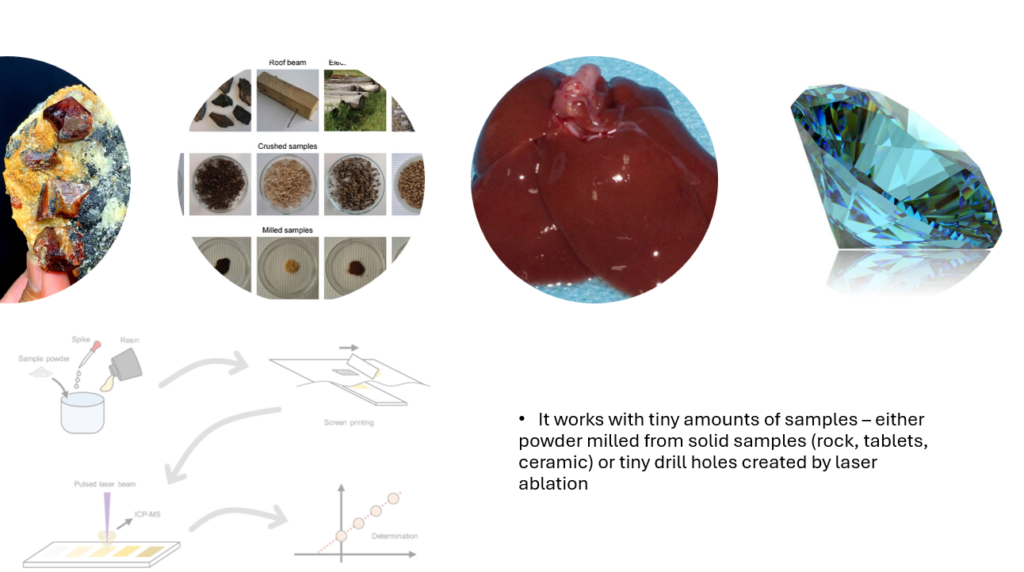
One of the major advantages of ICP-MS is that only a very small amount of material is required for analysis. This makes the technique particularly useful when samples are rare, valuable, difficult to obtain, or cannot be extensively damaged.
ICP-MS can analyse many different types of materials, including rocks and minerals, soils, biological tissues, archaeological materials, gemstones, ceramics, and manufactured products.
There are two main ways in which solid materials can be introduced for ICP-MS analysis:
Solution analysis: A small amount of the sample is crushed or milled into a fine powder. The material is then chemically dissolved, normally using acids, before being introduced into the ICP-MS as a liquid.
Laser ablation (LA-ICP-MS): A focused laser beam removes a microscopic amount of material directly from the surface of the solid sample. The resulting particles are transported by a carrier gas into the ICP-MS for analysis.
Laser ablation is especially powerful because individual minerals, growth zones, inclusions, biological structures, or other microscopic features can be targeted without having to dissolve the entire sample.
The amount of material removed can be extremely small. Laser spots are commonly only tens to hundreds of micrometres in diameter, yet they can provide enough material to determine elemental concentrations and, in suitable applications, precise isotope ratios.
The key advantage: ICP-MS can extract a remarkable amount of chemical and isotopic information from an extremely small amount of sample.
Precision and Accuracy in Isotope Analysis
One of the major strengths of ICP-MS, particularly MC-ICP-MS, is its ability to measure isotope ratios with extremely high precision and accuracy. Although these terms are sometimes used interchangeably, they describe two different aspects of analytical quality.
Precision describes how closely repeated measurements agree with one another. If the same sample is analysed several times and produces very similar isotope ratios, the measurements have high precision.
Accuracy describes how close the measured value is to the true or accepted value. Accuracy is commonly evaluated by analysing certified reference materials with well-characterized isotope compositions.
A good analytical method should ideally provide both high precision and high accuracy.
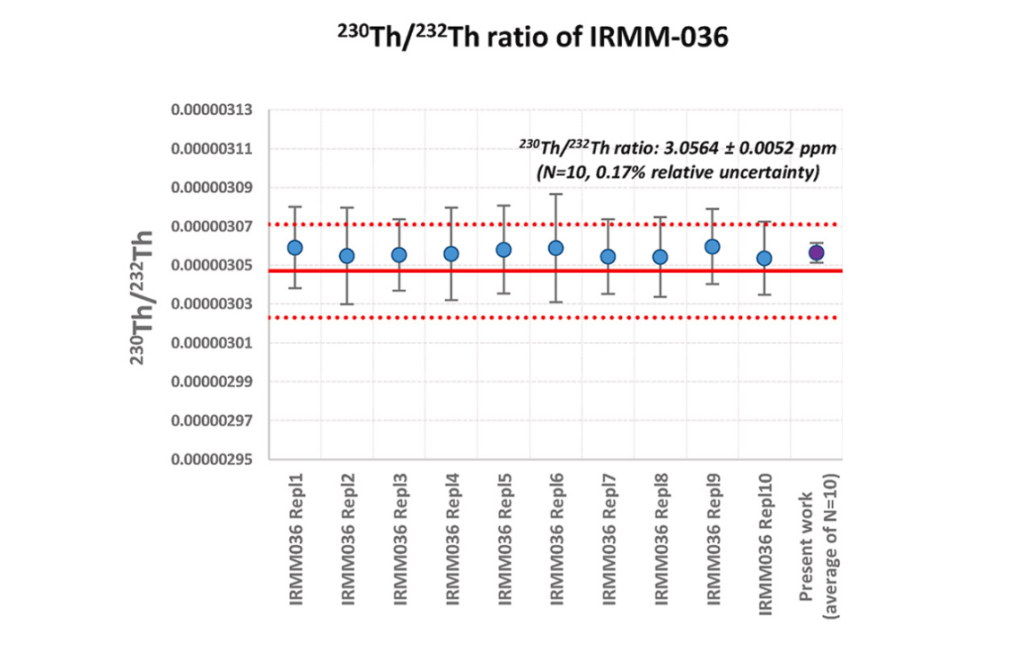
Example: ²³⁰Th/²³²Th measurement
The figure shows 10 replicate measurements of the IRMM-036 reference material. The individual measurements cluster very closely together, demonstrating excellent reproducibility and precision.
The measured ²³⁰Th/²³²Th ratio is 3.0564 ± 0.0052 ppm, corresponding to only 0.17% relative uncertainty.
The error bars represent the uncertainty associated with each individual measurement, while the close agreement between all ten measurements demonstrates that the instrument can repeatedly reproduce essentially the same isotope ratio.
If the measured mean also agrees, within uncertainty, with the certified/reference value for IRMM-036, then the measurement can also be considered accurate.
Precision = Can we reproduce the same result? Accuracy = Is that result close to the correct value?
Laser Ablation ICP-MS: Analysing Samples Directly
One of the most powerful ways to introduce samples into an ICP-MS is laser ablation (LA-ICP-MS). Instead of dissolving the entire sample, a laser is used to remove a very small amount of material from a precisely selected location.
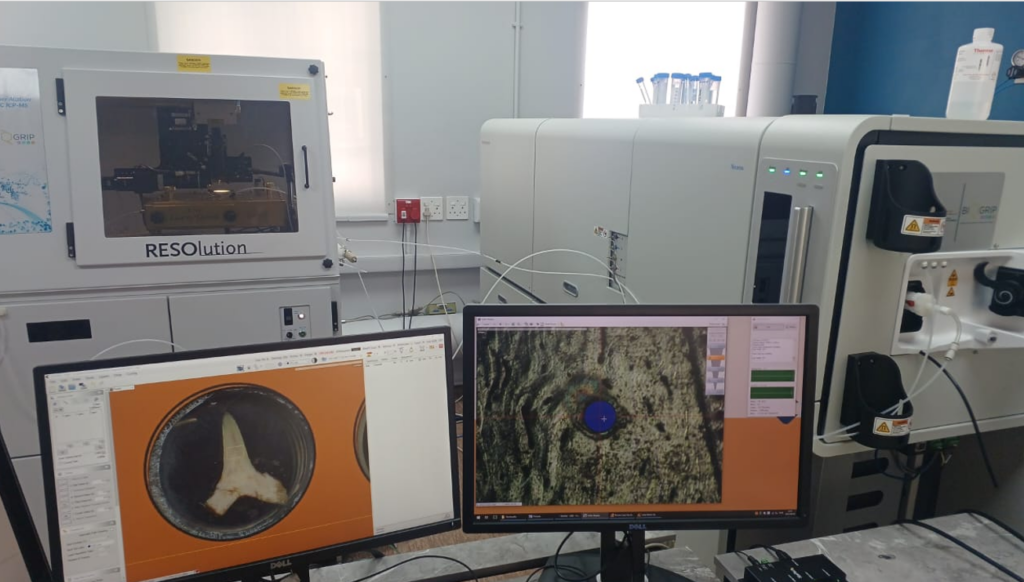
The photograph shows a laser ablation system coupled to an ICP-MS. The sample is placed inside the laser-ablation cell, where it can be viewed through a camera and positioned precisely before analysis.
How does it work?
Select the area of interest: The sample is viewed under the microscope and a specific location is chosen for analysis.
Fire the laser: A focused laser beam strikes the sample surface and removes a microscopic amount of material — a process called ablation.
Create an aerosol: The ablated material forms extremely fine particles.
Transport the sample: A carrier gas, typically helium, transports these particles from the laser cell to the ICP-MS.
Ionize and measure: The particles enter the plasma, where they are atomized and ionized. The resulting ions are then separated and measured by the mass spectrometer.
Why is laser ablation so useful?
Because the analysis is spatially resolved, we can target specific microscopic parts of a sample rather than measuring the bulk material.
The shark tooth shown in the photograph is a good example. We can position a laser spot on a particular part of the tooth and analyse only that tiny region. From such analyses, elemental and isotopic information can be used to investigate the age, environmental conditions and chemical history recorded by the tooth.
Solution-Mode ICP-MS
In solution-mode ICP-MS, the sample is introduced into the instrument as a liquid. This is the conventional approach for analysing water samples, dissolved solids, digested rocks, soils, biological materials, and many other sample types.
How does solution introduction work?
Sample preparation: The sample must first be in solution. Water samples may require only filtration and acidification, whereas solid samples generally need to be dissolved by acid digestion.
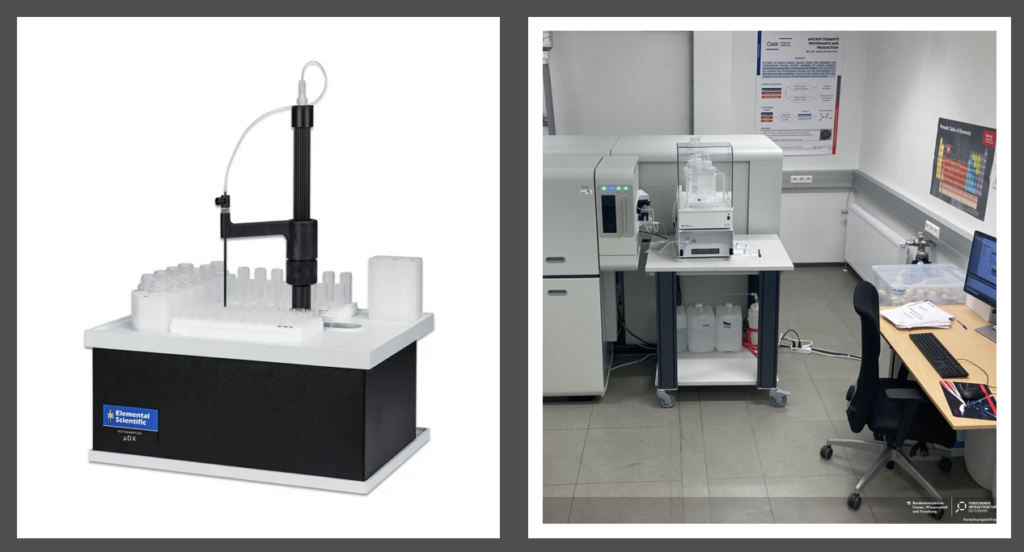
Autosampler: Prepared samples are placed in tubes on an autosampler, which allows many samples, standards and blanks to be analysed automatically.
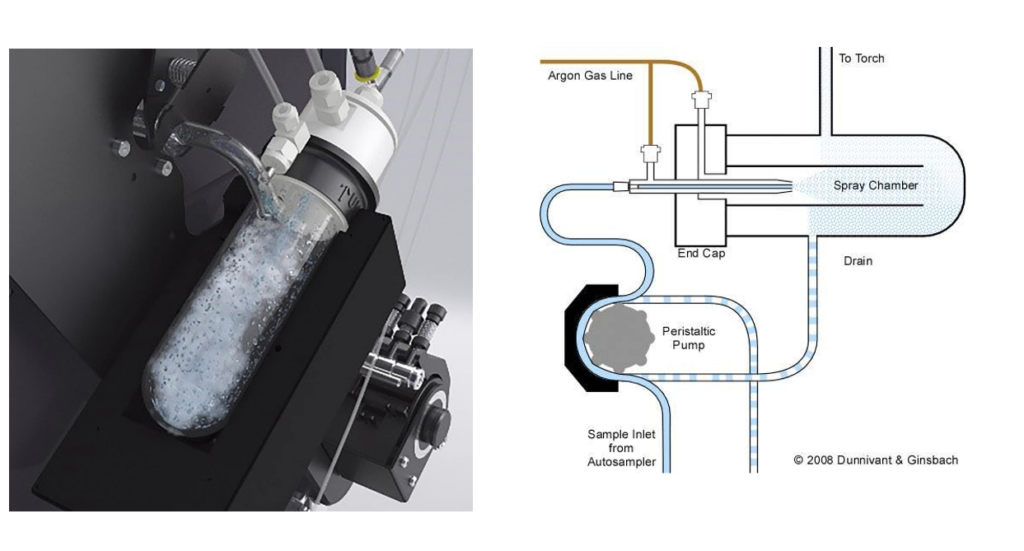
Nebulization: A small amount of solution is continuously pumped into a nebulizer, which converts the liquid into a very fine aerosol.
Spray chamber: Large droplets are removed, while the finest droplets are transported toward the plasma.
Plasma: The aerosol enters the hot argon plasma, where the sample is desolvated, vaporized, atomized and ionized.
Mass spectrometry: The ions enter the mass spectrometer, where they are separated according to their mass-to-charge ratio (m/z) and measured.
Why use solution mode?
Solution analysis is particularly useful when we want the bulk chemical or isotopic composition of a sample. It also allows samples to undergo chemical purification before analysis, which can be essential for high-precision isotope measurements.
For example, for Sr isotope analysis of water, Sr can first be separated from the sample matrix using Sr-specific resin. The purified Sr fraction is then dissolved in dilute acid and introduced into the MC-ICP-MS using the solution introduction system.
From Liquid Sample to Aerosol: Nebulizer and Spray Chamber
Before a liquid sample can enter the plasma, it must first be converted into a fine aerosol. This is achieved by the nebulizer and spray chamber.
1. Sample uptake
The liquid sample is drawn from the sample tube by a peristaltic pump.
The pump provides a controlled and continuous flow of solution toward the nebulizer.
2. Nebulization
The sample enters the nebulizer, where it meets a high-velocity flow of argon gas.
The argon breaks the liquid stream into a mist containing droplets of different sizes.
This process is called nebulization.
3. Droplet separation in the spray chamber
The aerosol then enters the spray chamber, which acts as a droplet-size filter.
Large droplets are removed because they are inefficiently transported and could destabilize the plasma.
These large droplets condense on the walls of the chamber and leave through the drain.
Only the finest aerosol droplets remain suspended in the argon gas.
4. Transport to the plasma
The fine aerosol exits the spray chamber and is transported by the argon gas to the ICP torch, where the next stage of the analysis begins.
After the sample has been converted into a fine aerosol, it is transported by argon gas into the ICP torch. This is where the sample is transformed into ions that can be analysed by the mass spectrometer.
What is the plasma?
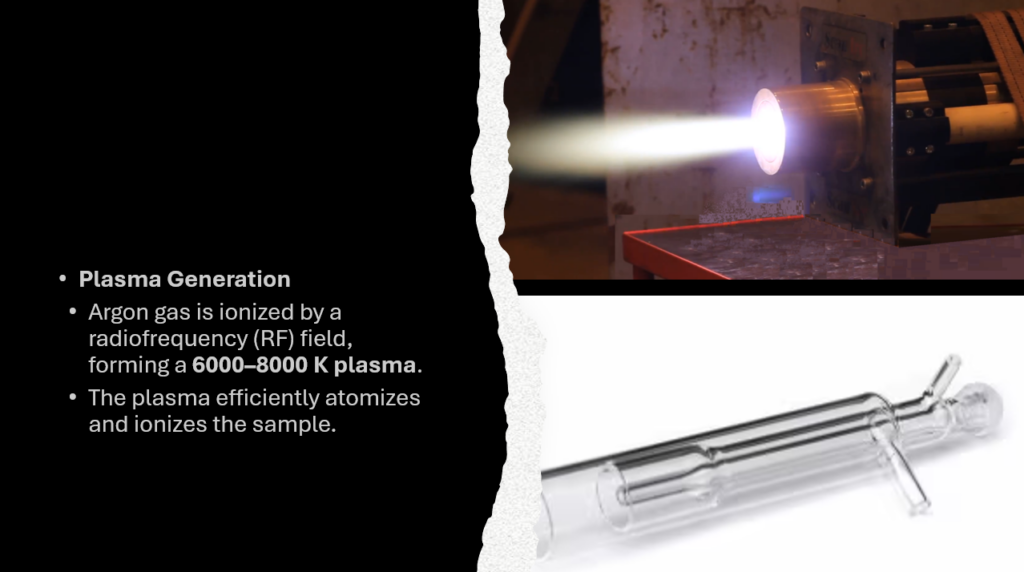
The plasma is an extremely hot, electrically conductive gas formed from argon. In an ICP-MS, it typically reaches temperatures of approximately 6000–8000 K.
An RF (radiofrequency) coil surrounds the upper part of the quartz torch. An alternating electrical current passing through this coil generates a rapidly changing electromagnetic field.
How is the plasma formed?
Argon gas flows continuously through the quartz torch.
A high-voltage spark initially provides free electrons to start the ionization process.
The RF electromagnetic field accelerates these electrons.
Collisions between energetic electrons and argon atoms produce additional Ar⁺ ions and electrons.
This creates a self-sustaining, extremely hot argon plasma.
What happens to the sample?
As the aerosol passes through the plasma, it undergoes a rapid sequence of transformations:
Droplets → Dry particles → Gas → Atoms → Ions
More specifically:
Desolvation – the solvent evaporates ↓ Vaporization – the remaining solid material becomes gaseous ↓ Atomization – molecules are broken into individual atoms ↓ Ionization – electrons are removed from atoms, producing mainly positively charged ions (M⁺)
These ions are what the mass spectrometer ultimately measures.
The main job of the ICP is therefore simple: take the sample and efficiently convert its elements into ions.
Mass Separation and Detection
Once the sample has been ionized in the plasma and transferred into the mass spectrometer, the ions must be separated according to their mass-to-charge ratio (m/z).
In a multi-collector ICP-MS (MC-ICP-MS), this separation allows several isotopes to be measured simultaneously, which is essential for obtaining very precise isotope ratios.
How are the isotopes separated?
The ions first form a focused ion beam inside the mass spectrometer.
The beam passes through a magnetic field.
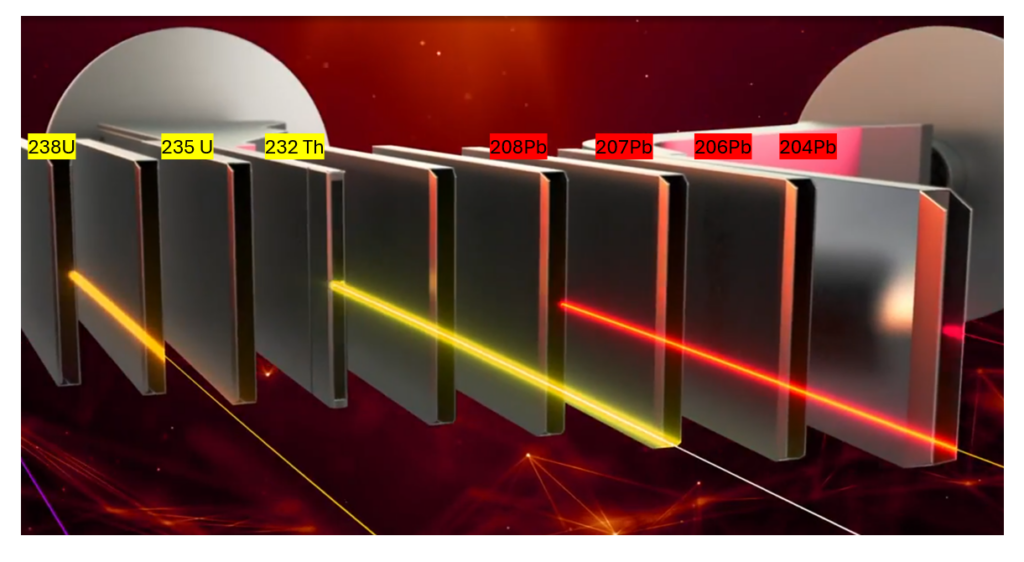
Because isotopes have different masses, the magnetic field bends their trajectories by slightly different amounts.
The result is a spatial separation of the isotopes into individual ion beams.
Simultaneous isotope measurement
The figure illustrates this using the U–Th–Pb system. Ions such as ²⁰⁴Pb, ²⁰⁶Pb, ²⁰⁷Pb, ²⁰⁸Pb, ²³²Th, ²³⁵U and ²³⁸U follow slightly different trajectories through the magnetic field.
At the end of the flight path, the separated ion beams arrive at different detectors or collectors. In a multi-collector instrument, several isotope beams can therefore be measured at exactly the same time.
This simultaneous measurement is one of the reasons MC-ICP-MS can achieve such high precision: variations in the ion beam affect the isotopes together rather than being measured at different times.
From ion beams to isotope ratios
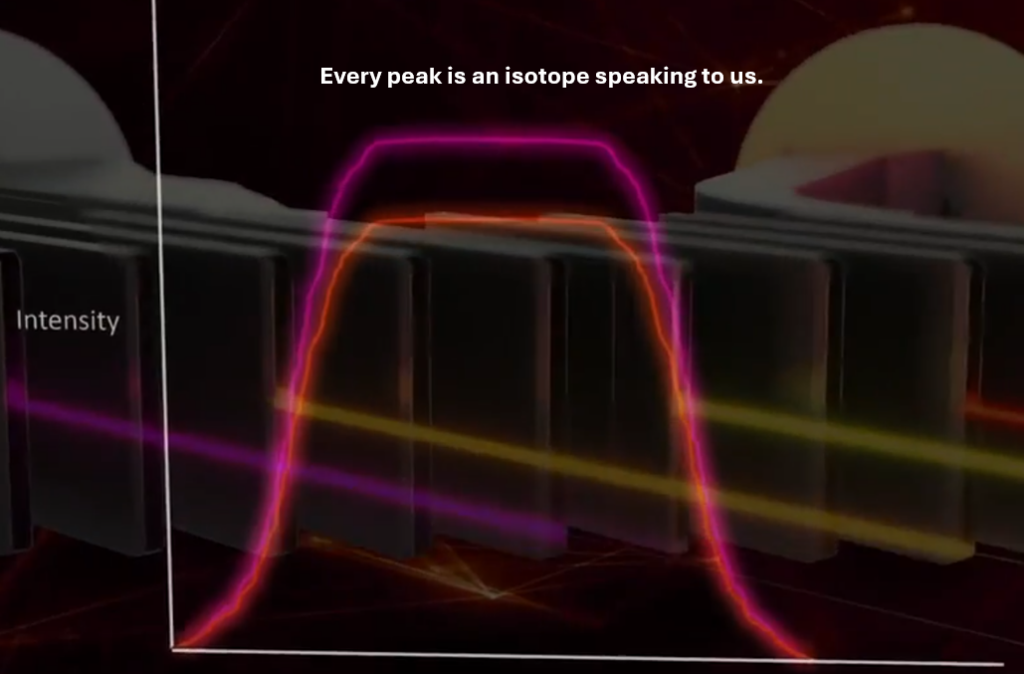
Each detector converts the incoming ion beam into an electrical signal. The intensity of that signal is proportional to the number of ions reaching the detector.
From Ion Beams to Signals
Once the separated isotope beams reach the detectors, the ions are converted into electrical signals that can be measured by the instrument.
The signal intensity reflects the number of ions reaching the detector.
When no sample is entering the instrument, only a low background signal is measured.
As the sample reaches the plasma and ion beam intensity increases, the signal rises.
During a stable analysis, the signal forms a relatively constant plateau. This is the region from which isotope ratios are normally calculated.
When the sample supply stops, the signal decreases again toward the background level.
In a multi-collector ICP-MS, several isotope signals are recorded simultaneously. Their relative intensities are used to calculate isotope ratios such as ⁸⁷Sr/⁸⁶Sr.
Why is a stable signal important?
For high-precision isotope analysis, we want a signal that is strong and stable. Fluctuations in sample introduction, plasma conditions or ion transmission can increase the uncertainty of the measurement.
The detector converts an invisible beam of ions into a measurable electrical signal — and that signal becomes our isotope data.
Isotopes as Tracers of Environmental Processes
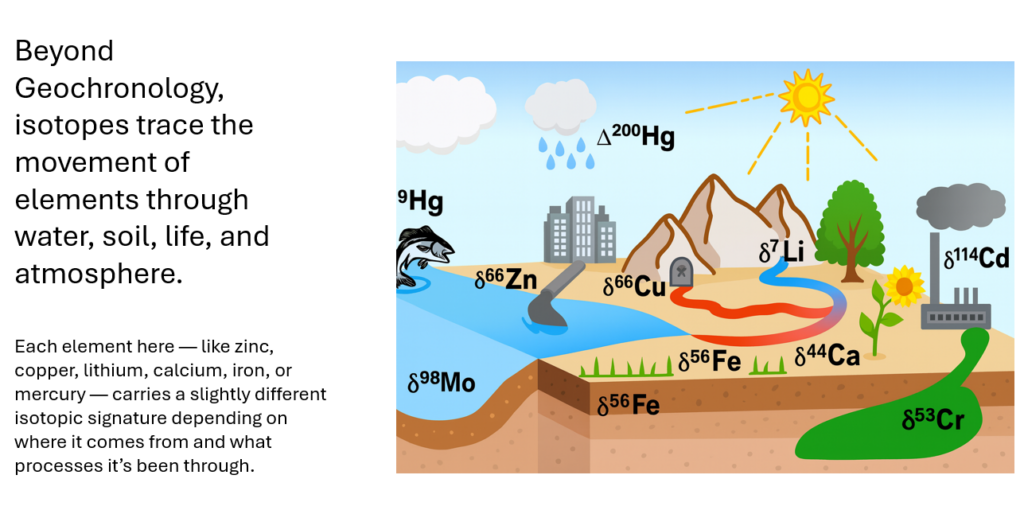
Isotope geochemistry is not only about determining the age of rocks and minerals. Isotopes can also be used as natural tracers to understand how elements move between the atmosphere, water, soil, rocks and living organisms.
Different sources and environmental processes can produce characteristic isotopic signatures. By measuring these small variations, we can investigate both where an element came from and what happened to it during transport through the environment.
What can isotope tracers tell us?
Source: Is the element derived from rocks, rivers, groundwater, the atmosphere, industry, agriculture, or another source?
Transport: How does the element move between soil, groundwater, rivers and oceans?
Mixing: Are two or more sources contributing to the same water or soil?
Environmental processes: Weathering, biological activity, adsorption, precipitation and other processes can modify the isotopic composition of some elements.
Pollution: Isotopes can help distinguish natural background concentrations from anthropogenic contamination.
A wide variety of isotope systems can be used, including Li, Fe, Cu, Zn, Mo, Cd, Hg and Cr, with each system providing information about different environmental processes.
For example, isotope measurements can be used to investigate weathering in river catchments, metal mobility in soils, contamination from industrial sources, nutrient cycling, and the transfer of pollutants through aquatic food webs.
Strontium Isotopes as Tracers in Natural Waters
Strontium (Sr) isotopes are particularly powerful tracers in hydrology and environmental geochemistry because dissolved Sr in water is strongly influenced by the geological materials with which the water interacts.
Two complementary measurements are particularly useful: Sr concentration and the ⁸⁷Sr/⁸⁶Sr isotope ratio. Together, they provide information about the origin of the water, mixing between different water sources, and water–rock interaction.
Why does ⁸⁷Sr/⁸⁶Sr vary?
Strontium has four naturally occurring stable isotopes: ⁸⁴Sr, ⁸⁶Sr, ⁸⁷Sr and ⁸⁸Sr. Importantly, ⁸⁷Sr is also produced through the radioactive decay of ⁸⁷Rb.
Consequently, rocks of different ages and compositions can have very different ⁸⁷Sr/⁸⁶Sr ratios. When water interacts with these rocks, weathering releases Sr into solution and transfers part of this geological isotopic signature to the water.
Tracing water–rock interaction
Different minerals and rock types release Sr at different rates. For example, carbonates, silicate minerals and evaporites can all contribute dissolved Sr to natural waters.
As a result, the Sr isotope composition of:
Rain → Surface water → Rivers → Groundwater → Ocean
can evolve as water moves through the environment and interacts with different geological materials.
Groundwater can be especially informative because prolonged contact with the aquifer allows its Sr concentration and ⁸⁷Sr/⁸⁶Sr composition to develop a strong relationship with the aquifer lithology.
What can we use Sr isotopes for?
Sr concentration combined with ⁸⁷Sr/⁸⁶Sr can help us:
identify different water sources;
determine the influence of catchment and aquifer geology;
trace groundwater recharge;
identify groundwater–river interaction;
investigate mixing between different rivers or water bodies;
distinguish different sources of dissolved Sr.
The Principle Behind Strontium Isotopes
To understand why Sr isotopes are such useful tracers, we first need to understand where the variation in ⁸⁷Sr/⁸⁶Sr comes from.
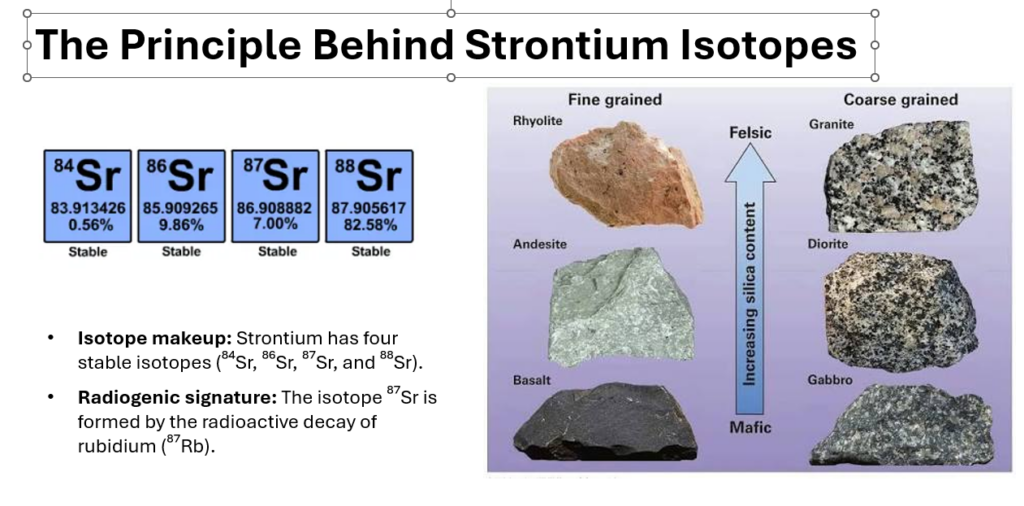
Strontium has four naturally occurring stable isotopes: ⁸⁴Sr, ⁸⁶Sr, ⁸⁷Sr and ⁸⁸Sr. Of these, ⁸⁷Sr is special because it is also radiogenic: it is continuously produced by the radioactive decay of ⁸⁷Rb.
The ⁸⁷Rb → ⁸⁷Sr decay system
Rubidium behaves chemically in a similar way to potassium and is therefore preferentially incorporated into K-rich minerals, such as feldspars and micas. Consequently, many felsic continental rocks, particularly granitic rocks, can have relatively high Rb/Sr ratios.
Over geological time:
⁸⁷Rb → ⁸⁷Sr + β⁻
As ⁸⁷Rb decays, radiogenic ⁸⁷Sr accumulates. Therefore, the ⁸⁷Sr/⁸⁶Sr ratio of a rock depends strongly on:
its initial Sr isotope composition;
its Rb/Sr ratio; and
the time available for ⁸⁷Rb to decay.
Why do different rocks have different Sr isotope signatures?
In general, old, Rb-rich continental rocks can develop relatively high ⁸⁷Sr/⁸⁶Sr ratios and are described as radiogenic.
In contrast, young mantle-derived mafic rocks, such as basalts, generally have lower Rb/Sr ratios and tend to have lower, less radiogenic ⁸⁷Sr/⁸⁶Sr signatures.
This difference between rock types is fundamental to using Sr isotopes as environmental tracers.
Connecting rocks to water
When these rocks undergo chemical weathering, Sr is released into rivers and groundwater. The water therefore acquires an Sr isotope signature related to the minerals and rocks being weathered within the catchment or aquifer.
Different geology → different ⁸⁷Sr/⁸⁶Sr → different water signatures
This is why measuring ⁸⁷Sr/⁸⁶Sr in water can tell us something about where the dissolved Sr came from and which rocks the water has interacted with.
Bedrock Geology, Weathering and River Sr Isotopes
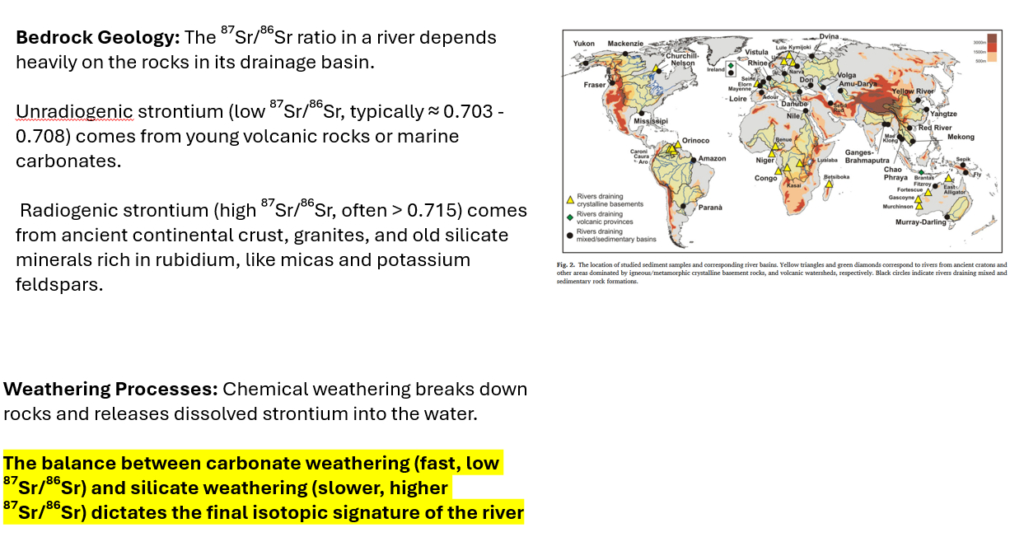
The ⁸⁷Sr/⁸⁶Sr ratio of river water is strongly controlled by the geology of its drainage basin. As rainwater and groundwater interact with rocks, chemical weathering releases Sr from minerals into solution. The isotopic composition of this dissolved Sr reflects the materials being weathered.
Radiogenic and unradiogenic Sr
Different rock types can contribute very different Sr isotope signatures:
Unradiogenic Sr – lower ⁸⁷Sr/⁸⁶Sr: commonly associated with young mantle-derived volcanic rocks and many marine carbonates.
Radiogenic Sr – higher ⁸⁷Sr/⁸⁶Sr: commonly associated with old continental crust and Rb-rich silicate rocks, including granites and minerals such as K-feldspar and mica.
Consequently, rivers draining different geological terrains can have distinctly different ⁸⁷Sr/⁸⁶Sr ratios.
The importance of weathering
However, the Sr isotope composition of a river is not simply the average composition of the rocks in the catchment. What matters is the Sr that is actually released into the water during weathering.
Carbonate minerals generally weather relatively rapidly and can release significant amounts of Sr into solution. Silicate minerals generally weather more slowly, but weathering of old Rb-rich continental rocks can supply much more radiogenic Sr.
Therefore, the dissolved Sr isotope composition of a river reflects the relative contributions from different weathering sources:
Carbonate weathering → commonly less radiogenic Sr Silicate weathering → can provide more radiogenic Sr
The competition between these sources produces the final ⁸⁷Sr/⁸⁶Sr signature carried by the river.
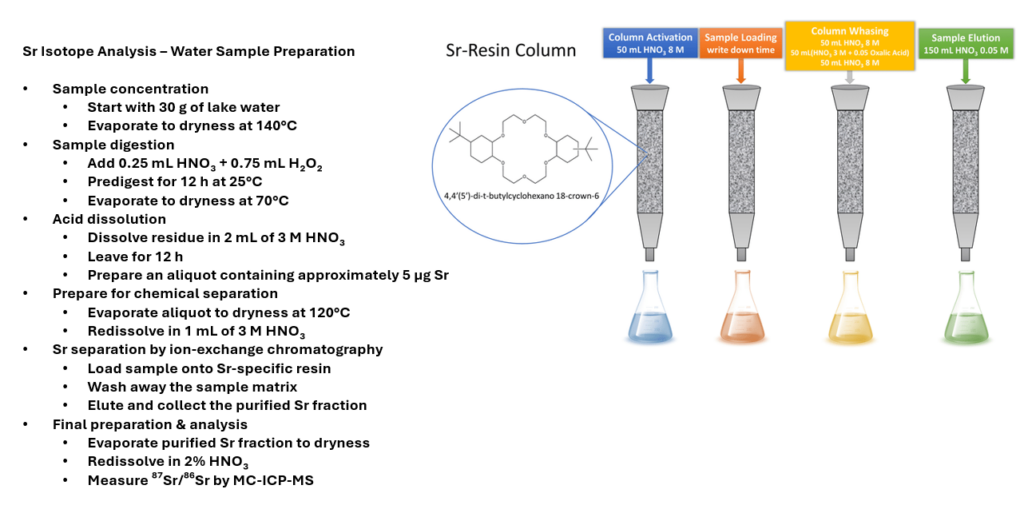
Preparing Water Samples for Sr Isotope Analysis
High-precision ⁸⁷Sr/⁸⁶Sr measurements require Sr to be separated from the other elements present in the water sample. This is important because the sample matrix and elements such as Rb can interfere with accurate Sr isotope measurements.
The preparation therefore involves two main stages: concentrating and preparing the sample, followed by chemical purification of Sr using an Sr-specific resin column.
1. Concentration and digestion
A measured amount of water is first evaporated to dryness, concentrating the dissolved elements into a small residue.
The residue is treated with HNO₃ and H₂O₂. This helps break down remaining organic material and prepares the sample for subsequent chemical separation.
After another evaporation step, the residue is dissolved in 3 M HNO₃. An aliquot containing sufficient Sr is then selected for column chemistry.
2. Sr separation using Sr-specific resin
The sample is passed through a column containing a resin designed to selectively retain Sr.
The separation can be understood in four simple stages:
Column activation → Sample loading → Washing → Sr elution
Column activation: The resin is conditioned with HNO₃ so that it is ready to retain Sr.
Sample loading: The sample is added to the column. Under the appropriate acid conditions, Sr is retained by the resin.
Column washing: Acid is passed through the column to remove the sample matrix and unwanted elements, while Sr remains on the resin.
Sr elution: The acid conditions are changed so that Sr is released from the resin. The solution leaving the column is collected as the purified Sr fraction.
Why do we need to separate Sr?
One particularly important element to remove is rubidium (Rb). This is because ⁸⁷Rb and ⁸⁷Sr have the same nominal mass (mass 87). If Rb is present during the measurement, its signal can interfere with the determination of ⁸⁷Sr.
Removing the matrix also improves instrumental stability and allows the Sr isotope ratio to be measured with much greater accuracy and precision.
3. Final preparation and MC-ICP-MS analysis
The purified Sr fraction is evaporated to dryness and redissolved in dilute HNO₃. The solution is then introduced into the MC-ICP-MS, where the Sr isotopes are measured simultaneously and the ⁸⁷Sr/⁸⁶Sr ratio is determined.
The basic principle is: concentrate the sample → isolate Sr → remove interfering elements → collect purified Sr → measure ⁸⁷Sr/⁸⁶Sr.