
U–Pb Saturn 2.06: Faster, Smarter and More Interactive U–Pb Data Reduction
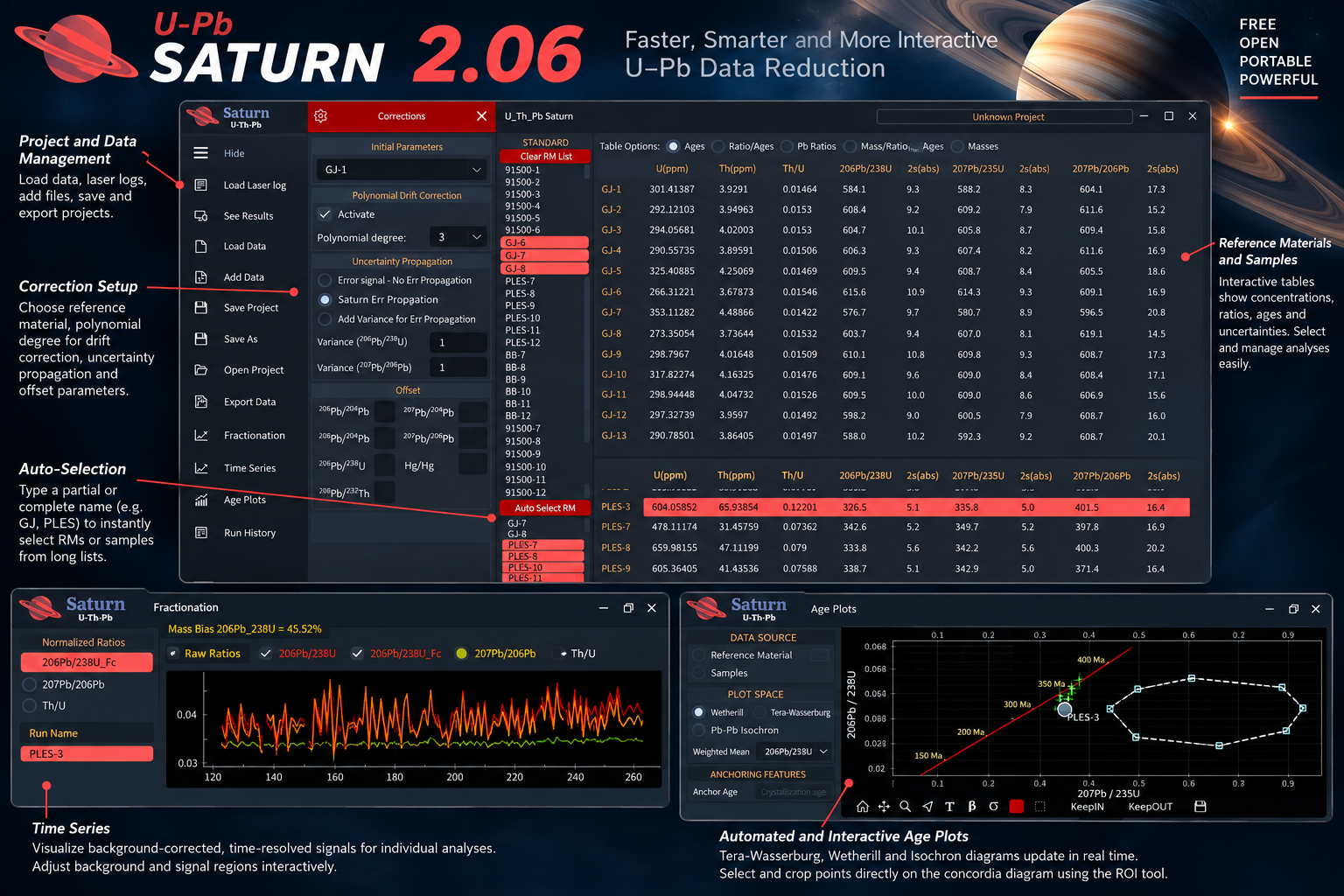
We are pleased to introduce U–Pb Saturn 2.06, the latest and most advanced version of our free, non-commercial platform for LA–ICP–MS U–Pb data reduction.
Saturn 2.06 represents a major step forward in the development of the software. The new version combines automated data organization, live reference-material and sample selection, laser-log integration, improved drift correction, automated plotting, and direct interaction with concordia diagrams within a single data-reduction environment.
The objective remains simple: make U–Pb data reduction faster and easier without removing control from the geochronologist.
One Platform for Different ICP-MS Systems
Saturn was developed to provide an instrument-independent environment for U–Pb data reduction. Version 2.06 supports datasets generated by a wide range of single- and multi-collector ICP-MS platforms, including Thermo Scientific iCAP, Neoma, Neptune and Element systems, Agilent ICP-MS instruments, and Nu Instruments AttoM.
This allows laboratories using different analytical configurations to work within the same Saturn environment while maintaining a consistent data-reduction workflow.
Laser Logs and Automated Analytical Sequences
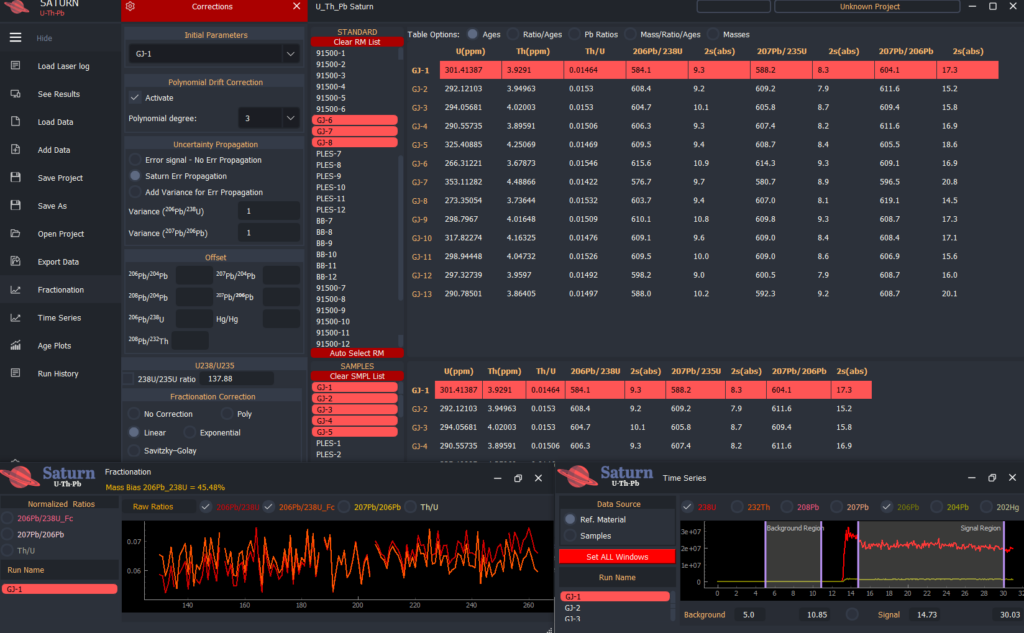
Saturn 2.06 introduces improved laser-log integration.
Laser-ablation logs can be loaded together with the ICP-MS data, allowing Saturn to associate the names recorded during the laser session with the corresponding mass-spectrometer files. This greatly simplifies the organization of long analytical sequences and reduces the need to rename individual ICP-MS files manually.
Click here for more: https://www.air.app.br/u-pb-saturn/
The resulting sequence can then be inspected before reference materials and unknowns are selected.
Live Auto-Selection of Reference Materials and Samples
Selecting analyses from large datasets is now considerably faster.
The new Auto-Selection system allows users to begin typing a reference-material or sample name—such as GJ, GJ1, or PLES—and Saturn immediately identifies and selects all matching analyses.
There is no need to scroll through hundreds of analyses or repeatedly press the selection button. Once the desired group has been selected, pressing Enter or clicking elsewhere closes the search field and the user can continue directly with data reduction.
Average and Drift-Corrected Data Reduction
Saturn 2.06 provides both average correction and time-dependent drift correction workflows.
When sufficient reference-material analyses are distributed throughout an analytical sequence, users can evaluate temporal changes in the correction factors and apply a polynomial drift model. The polynomial degree can be selected according to the behaviour and distribution of the reference-material data.
This makes it possible to account for changes in instrumental response during long analytical sessions while retaining direct graphical control over the correction model.
Interactive and Automated Plotting
One of the major developments in Saturn 2.06 is the tighter connection between data reduction and graphical visualization.
Signal windows, analytical tables, reference-material calculations and geochronological diagrams are interconnected. Changes to analytical selections can therefore be propagated directly to the calculated results and plots.
This provides immediate visual feedback and makes it much easier to identify problematic analyses, evaluate corrections and inspect complex datasets.
Edit Data Directly on the Concordia Diagram
Saturn 2.06 brings data editing directly into the geochronological plots.
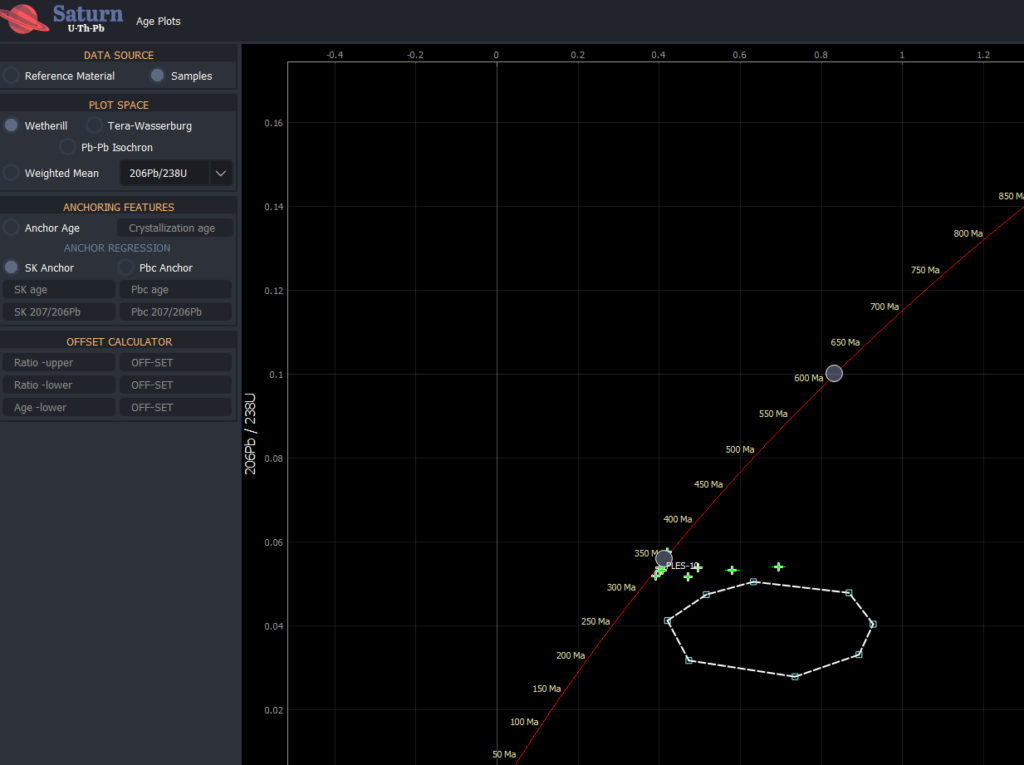
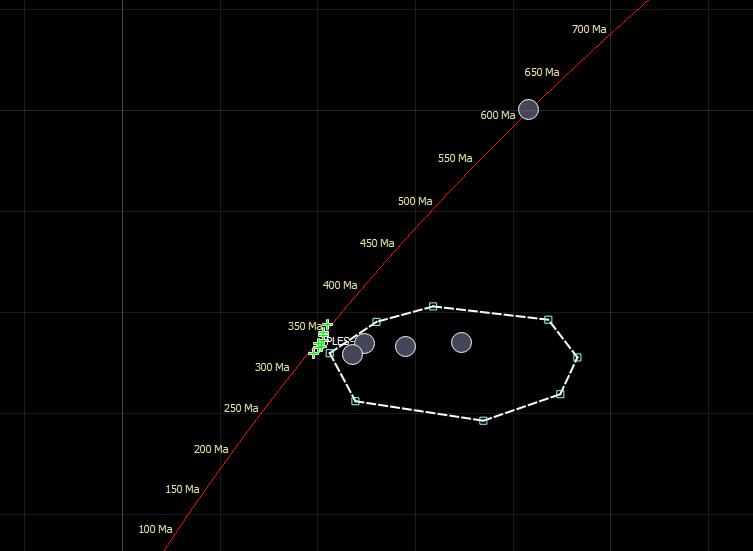
Individual analyses can be identified and cropped directly from the concordia diagram, eliminating the need to locate the same analysis manually in a separate table.
The new Region of Interest (ROI) tool extends this functionality further. Users can define a region directly on the concordia plot and interactively select groups of analyses within that area.
This provides a particularly efficient way to investigate coherent age populations, identify discordant analyses and explore complex U–Pb datasets.
Uncertainty Propagation
Following reference-material correction, Saturn provides integrated uncertainty propagation for the corrected isotope ratios and calculated ages.
Version 2.06 integrates uncertainty calculations directly into the data-reduction sequence so that changes to analytical selections, correction strategies and data-editing decisions can be rapidly reflected in the final results.
Designed for Large Datasets
Saturn was built with modern LA–ICP–MS analytical sessions in mind and can handle sequences containing up to approximately 1,000 analyses.
The combination of laser-log integration, Auto-Selection, interactive signal editing, automated plotting, drift correction and concordia-based data selection substantially reduces the amount of manual work required to process large datasets.
Portable and Free
U–Pb Saturn remains free and non-commercial.
The software is designed for portability and operates directly from its folder on Windows computers without activation keys or conventional installation procedures. This makes it easy to move Saturn between laboratory and personal computers and to use the same data-reduction environment across different laboratories.
A macOS version is currently under development.
Saturn 2.06: Data Reduction Meets Data Exploration
The development of Saturn 2.06 reflects a shift from conventional sequential data reduction toward a more interactive approach to geochronology.
Users can now move continuously between the analytical sequence, time-resolved signals, reference materials, correction models, calculated ages and concordia diagrams. Instead of simply producing a final table of ages, Saturn allows the geochronologist to see how each analytical decision affects the resulting U–Pb interpretation.
U–Pb Saturn 2.06 is available as a free download, together with step-by-step video tutorials covering data loading, laser-log integration, reference-material and sample selection, correction strategies, uncertainty propagation and interactive data interpretation.